


This is the third episode of a five-part series for The Colorado Dream: Happy Birthday! The stories in this series are part of the KUNC podcast The Colorado Dream, airing on Mondays beginning June 29. The podcast is available for download wherever you listen to podcasts and on KUNC.org.
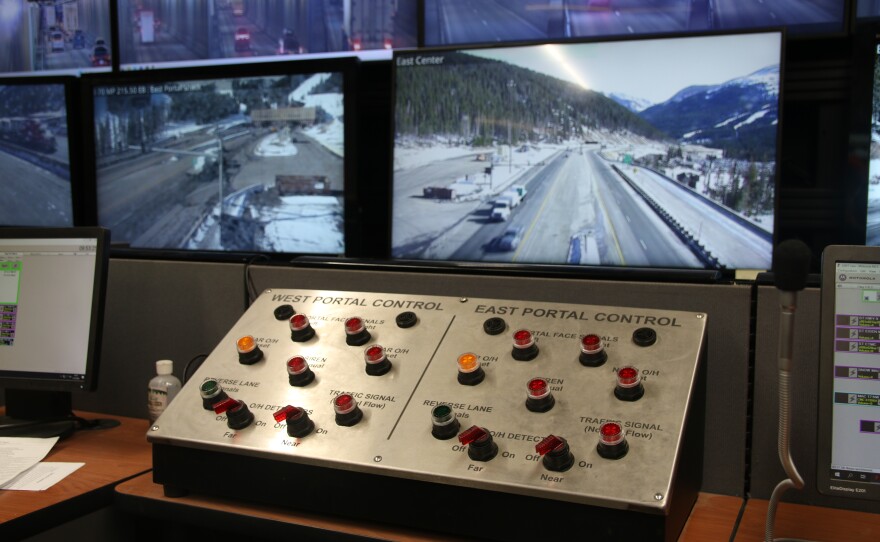
Next to the west end of Eisenhower Johnson Memorial Tunnels sits a non-descript Colorado Department of Transportation building. A large room in the basement looks like one of NASA’s Mission Control Centers. Dozens of large screens, organized in rows on the wall, flash between 150 different camera angles.
Below the massive view sits Rob Reid. He is the eye in the sky, watching for any disruptions.
Out of the corner of his eye, Reid sees a semi hauling a large house approaching the tunnel from the East.

“East, I'm holding your traffic, vehicle down,” Reid, the Control Room Operator for the tunnels, said to another operator in a different building. “I don't have eyes on it yet. North tunnel, right lane.”
Reid watches for problems every day, as tens of thousands of people pass through the mile-and-a-half long tunnels that cut through the Continental Divide. Thankfully, the oversized vehicle drives through just fine.
“East, we're good. I'm gonna go ahead and green up when you're clear, sir,” Reid said.
The Eisenhower Johnson Memorial Tunnels changed Colorado and the nation when they were constructed in the 1970s. A new West was born. Mountain towns were developed and turned into tourist destinations thanks to an interstate that runs through a mountain.
For centuries beforehand, the Rocky Mountains’ high peaks were a barrier, preventing easy access from the Eastern Plains to the Western Slope. The tunnels and roads we travel on to cross the Rockies today follow in the footsteps of those who first crossed this mountainous land: Native Nations.
Indigenous routes laid the blueprints
Indigenous people have lived and traveled across the Rocky Mountains for centuries, and according to some tribes, since the beginning of time. They were the first people who traveled by foot through Colorado’s high altitude peaks and rugged terrain.
Fred Mosqueda, a Southern Arapaho tribal historian and elder, said the land, which the tribe calls “Our Mother The Earth,” was shaped by weather and water, creating ideal pathways that the animals followed. These were the first mountain “roads” in Colorado.

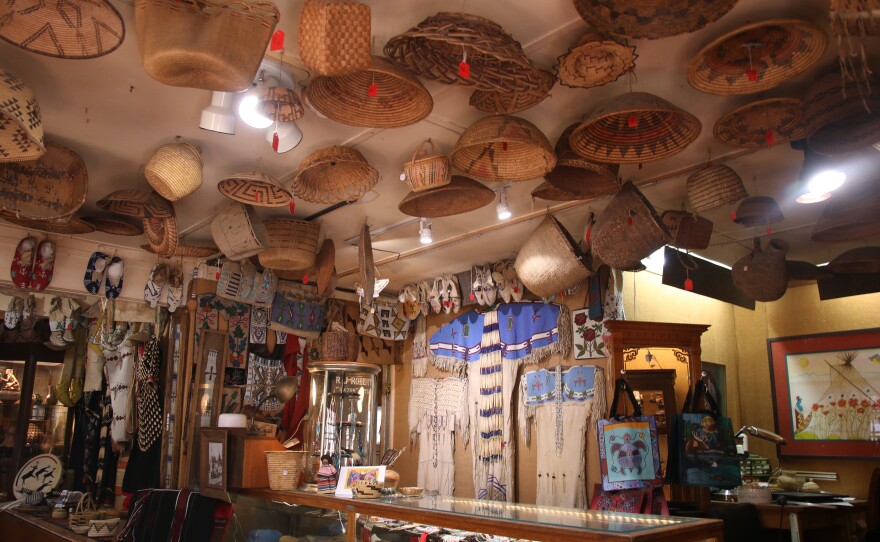
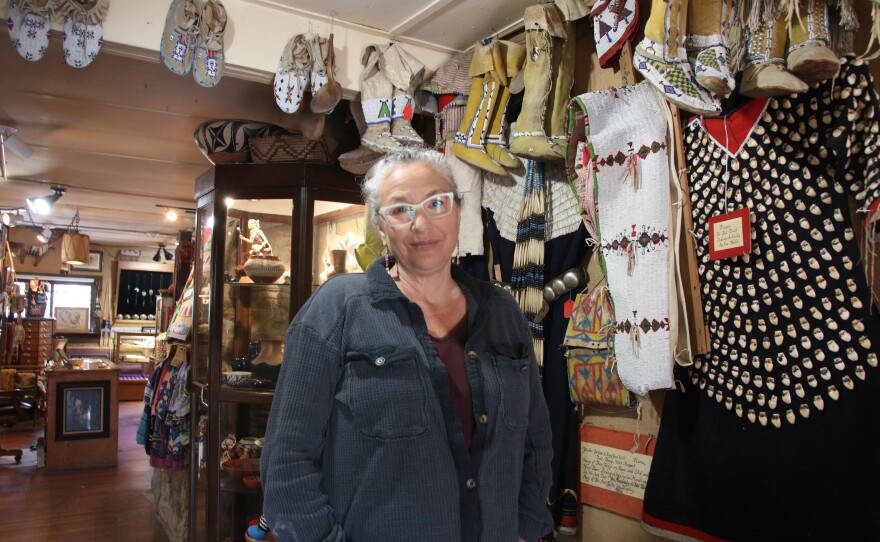
“You might say game trails became the highways through the mountains,” Mosqueda, an Arapaho Outreach Specialist for the Cheyenne and Arapaho Tribes of Oklahoma, said.
Mosqueda’s ancestors followed these routes because they made sense.
“They knew of an easier way to get around ‘em and to go for their food and their water,” Mosqueda said. “We would not have been climbing mountains or anything like that.”

The Arapaho Tribe would move themselves – and their stuff – up into the mountain areas every summer to follow their food and harvest their medicine plants. They’d come back down to the Eastern Plains in the winter, relying on warm buffalo hide and dried food to make it through the season. Their fortitude still amazes Mosqueda.
“I see the different trees that we used and everything, how did they cut those? How did they hunt and all this?” Mosqueda said. “I look at it and how we have it today, we can go to Walmart and buy everything.”
Those routes have created some of the most popular roads and hiking trails in Rocky Mountain National Park. Trail Ridge Road, at an elevation of over 12,000 feet, was known by the Arapaho as “Where The Children Walked,” since it was deemed too steep for families to hold their kids in carrier-like backpacks called cradle boards.
Old Fall River Road was called “Dog Trail” – a reference to where their dogs pulled a travois, or a two-pole, sled–like structure, to cross the mountains.
“The dogs that we had, well, you've seen how big wolves are, that's how big they were,” Mosqueda said. “These animals could carry 60 pounds of pack, and all these women would line them all up and pack them dogs.”
These routes helped form the paths and roads early settlers needed to move across Colorado’s Rocky Mountains.
Colorado's growth: boom or bust
Before Colorado became a state, it was home to over 51 Native Nations. When the prospectors first arrived, they had no interest in Colorado. The weather was harsh and bad for agriculture.
“They didn't see themselves as Coloradans, they didn't see themselves staying here,” Sam Bock, Director of Interpretation and Publications at History Colorado, said. “The vision was get in, get the nugget and get out and go back to Missouri. They weren't thinking about installing infrastructure at first.”
Then gold was discovered, and during the height of the Pikes Peak Gold Rush in 1859, over 100,000 people flocked to the area, and everything changed. The prospectors stayed and decimated the Native Nations with disease, warfare, forced relocation and cultural erasure. Today, the state only has two federally recognized tribes - the Southern Ute and the Ute Mountain Ute.
“We were gone completely out of Colorado,” Mosqueda said about the Arapaho Tribe. “When it became a state, we were so far away from here…I can’t celebrate (statehood), because we weren’t there.”

It was an inflection point. The prospectors took over the land. Unlike many Indigenous tribes, who moved around, they were sedentary, staying in the high country and becoming settlers. Towns sprang up overnight.
“It was kind of a haphazard, unplanned thing,” Bock said. “At first, for the most part, it was, ‘There's a path over that way that heads towards that hill where I think there's some gold.’”
Over time, people built railroads, narrow paved roads, and small tunnels to get around. But there was still no easy way to get through the Rockies or get over the Continental Divide.
That all changed after the creation of one of the country's greatest engineering and transportation marvels that opened up travel across Colorado and made mining towns into sought-after destinations: The Eisenhower Johnson Memorial Tunnels.
Tunnel fever
Back in the 1950s, there were two main roads that went over the towering Continental Divide: U.S. 6 over Loveland Pass, and U.S. 40 over Berthoud Pass. But gnarly winter conditions made them hard to maintain, and with so many sharp curves and steep grades, they’d often close during the winter.

“The state was somewhat disconnected,” CDOT Senior Historian Lisa Schoch said. “There was this idea of having an all-weather route through the Continental Divide that would help with that, and would connect the state better.”
Engineers started dreaming of a connected interstate that would go through a mountain. It was pitched as the Straight Creek project. There would be two tunnels: The North tunnel – later called the Eisenhower Tunnel – would travel West to Silverthorne. The South tunnel – eventually named the Johnson Tunnel – would head East to Denver.
Former Colorado Governor Edwin Johnson argued tunnels were necessary to advance travel and grow tourism. His contributions are what prompted the Johnson Tunnel to be named after him.
“He was very prideful about Western identity, and wanting people from the West working on the tunnel and designing the tunnel,” Schoch said. “So he was a pretty important voice in this tunnel even existing.”
The Eisenhower tunnel is named after President Dwight Eisenhower. He and his wife, Mamie, spent plenty of time recreating in the mountains in Grand County, which led to his personal desire for the tunnels. CDOT Public Relations Manager Bob Wilson has a theory.
“There's a story out there that he got stuck on Highway 40,” Wilson said. “He got so frustrated by the traffic jams going back into Denver that almost provided an impetus for him to say they need a bigger highway west of Denver as well.”
After years of deliberation, construction started on the North tunnel, the Eisenhower tunnel, in March 1968. At that time, it was the largest single federal highway project in the nation’s history.
The road to gender equality
A tunnel project on this scale had never been done before. It employed thousands of workers who were constantly troubleshooting soft rock and fault lines. One worker said, “We were going by the book, but the damned mountain couldn’t read.”

That wasn’t the only kind of pioneering going on. Enter Janet Bonnema, who was one of the only female workers on the Eisenhower Tunnel. Except she wasn’t offered a job. Some believe the employment officer misread her application.
“It said ‘JAMET,’ which is weird,” Schoch said. “I think they thought, whoever was looking at the applications, thought it was a guy.”
When the officer found out, he warned Bonnema not to take the job.
“Part of that, I think, oddly, is based on these Cornish mining myths that women in tunnels are bad luck,” Schoch said. “But I think the other part of it is that this just isn't something that women did at the time.”
Bonnema ended up taking the engineering technician job. But the contractor wouldn’t let her work. So Bonnema filed a sexual discrimination lawsuit and it was settled in her favor. She eventually got the right to work in 1973 when the state guaranteed equal rights for women.
“When they started letting her work in the tunnel, apparently 66 guys left, just walked out in protest,” Schoch said. “So obviously strong feelings about women being in certain roles.”
Despite this, Bonnema stayed the course until the Eisenhower tunnel was completed later that year.

Her persistence pushed the door open for other women to work on the tunnels like Karall Heimann.
Heimann was 20 years old when she was asked to weld light brackets on the Johnson tunnel in 1979. But the work was difficult. Every day she stood on a high scaffold holding dangerous power tools. Electricity could be spotty.
“This scaffold had a hole in the platform, so when the lights went out, I just sat down right where I was,” Heimann said. “I knew not to move. I could not see my hand with it touching my nose.”
Heimann faced opposition as one of the only females working on the tunnels. Some men said she couldn’t do the work, or asked her how much money she was making. But Heimann tried to do her best.
“I did have an awareness that I would be looked at and judged, or all women would be judged by the work that I did there,” she said.
In late December 1979, Heimann watched as the Johnson tunnel opened. Finally, there were two complete tunnels, marking the end of roughly 10 years of construction. The whole project ended up costing more than $260 million.
Historic mile marker
It’s hard to believe the Eisenhower Johnson Memorial Tunnels have only been around for about 50 years. But during that time, they have completely changed the I-70 Mountain Corridor.

When these vehicular tunnels were built, they were the longest in North America. And to this day, they’re still the highest active tunnels in the United States, at more than 11,000 feet. But these records are only one part of their impact on Colorado.
“It did alter our identity,” Schoch said. “It put us on the map, more or less. It changed our state history with transportation. It gave us that connection with the interstate.”
Before the tunnel opened, Colorado’s Western Slope was mostly rural. Wilson said small, quiet ranching towns dotted the mountainous landscape.
“Vail was kind of the only location that you would hit that actually had like a ski town,” Wilson said. “It was a small ski town at that time, but all these other locations that have exploded over the years had not come into being.”
The tunnels ushered in a new era of travel in the 1970s. Ski resorts were booming. People wanted to live in the mountains, and plenty more wanted to visit.
Historians have called this the “New West” – a shift from "boom-and-bust" towns created to extract mining resources quickly and leave, to service-forward towns aimed at tourism and recreation. Now many of these mountain towns have become overcrowded and expensive places to live.

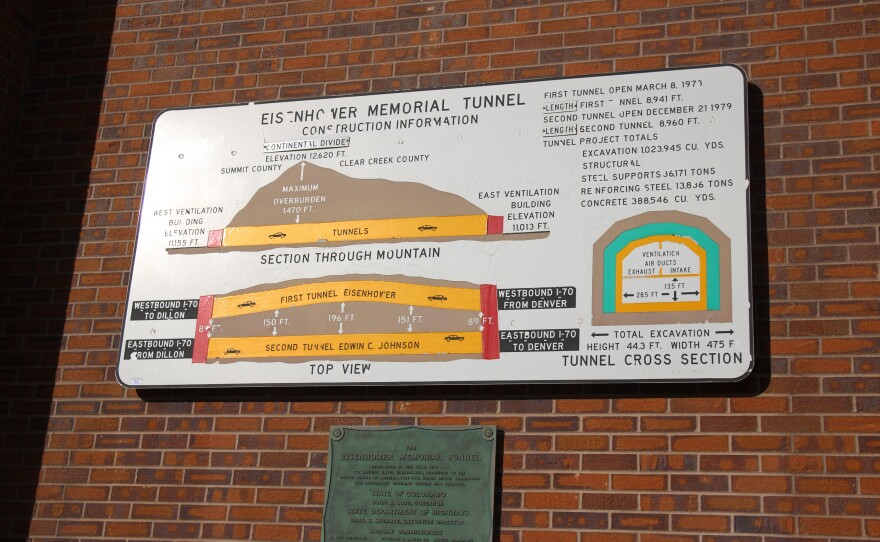

Sam Bock with History Colorado said the tunnels changed the state’s trajectory.
“We have created something from nothing. We have eked out a living in a place that, honestly, people probably shouldn't put cities and towns,” Bock said. “And yet, here we are thriving, and we love this place because of the lifestyle and because of the beauty and our connection to what is now our home.”
Next episode
Colorado’s legacy wasn’t formed only by tunnels and trails — it’s also been formed by conflict.
Hear how a massacre in 1914 became a turning point for how workers in Colorado are treated today.
Subscribe now where you get podcasts.
Credits
The Colorado Dream, Season 6: “Happy Birthday” is a production of KUNC News. It is hosted, produced and edited by Stephanie Daniel. This episode was written and reported by Emma VandenEinde. Additional editing by Sean Corcoran. The theme song was composed by Jason Paton. Michelle Redo sound designed and mixed the episode. Alex Murphy is the digital editor.
Special thanks to Rachel Cohen, Kyle McKinnon, Leigh Paterson, Kimberly Rais and History Colorado. Tammy Terwelp is KUNC’s president and CEO.
